The Ultimate Guide to Church Tents for Sale in Uganda: Seating Options, Pricing, Fabric Quality, and Maintenance
For faith-based organizations across East Africa, a church tent represents far more than temporary event hardware. In both urban centers like Kampala, Mukono, and Wakiso, and rapidly expanding rural communities across Uganda, church tents serve as structural foundations for growing congregations. They offer an adaptable, cost-effective alternative to permanent brick-and-mortar sanctuaries, allowing ministries to establish local presence, scale up layout dimensions as attendance thrives, and shield worshipers from the unpredictable tropical elements.
However, sourcing a structural shelter requires a deep understanding of manufacturing processes, material engineering, financial options, and transport constraints. Purchasing the incorrect structural framework can lead to ongoing material leaks, premature frame failure during intense seasonal windstorms, and unnecessary financial stress.
This technical FAQ handbook compiles the most critical procurement, configuration, and structural queries into an exhaustive resource for church committees, administrative ministries, and pastoral leadership networks seeking church tents for sale in Uganda.
Pillar 1: Understanding Church Tent Configurations, Capacity, and Market Sizing
1. How do tent manufacturers determine the seating capacity of church tents in Uganda?
The specified seating capacity of a church equipment package is based directly on standard plastic stacking chairs (such as the ubiquitous multi-purpose heavy-duty chairs widely used across East Africa) arranged in a traditional corporate configuration. This standard layout assumes closely packed rows with minimal spacing between individual seats, running perpendicular to a main central aisle leading toward the altar or stage platform.
When choosing a configuration for a sanctuary layout, ministry teams must remember that these standard manufacturing metrics do not automatically account for:
-
A raised, wide altar stage or platform for pastoral leaders, musical worship teams, and sound equipment.
-
The physical space required for extensive instruments, mixing boards, loudspeakers, and media desks.
-
Spacious paths between rows to allow the congregation to move safely during offering collections, alter calls, and prayer lines.
To prevent over-crowding, a wise rule of thumb is to purchase a structure rated for 20% to 30% more capacity than your baseline average attendance. For example, if your standard Sunday service hosts approximately 150 regular attendees, investing in a 200 seater structural framework ensures everyone remains comfortable and leaves ample room for future growth.
2. What are the common sizing specifications and capacity tiers for ministries in Uganda?
Church tents are typically manufactured in several standard capacity tiers tailored to the operational cycles of local ministries:
-
50 Seater Tents: Typically configured as a 5-meter by 5-meter or 6-meter by 6-meter square module. They are highly popular for cell group fellowships, small weekly mid-week prayer services, and newly established suburban church plants.
-
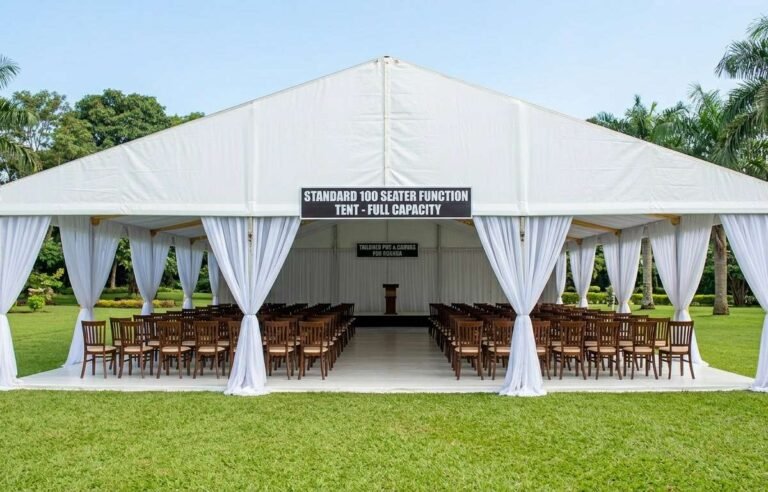
100 Seater Tents: Commonly built as a 5-meter by 10-meter or 6-meter by 12-meter rectangular setup. This size provides an ideal layout for mid-sized community fellowships, independent rural ministries, and youth auxiliary chapels.
-
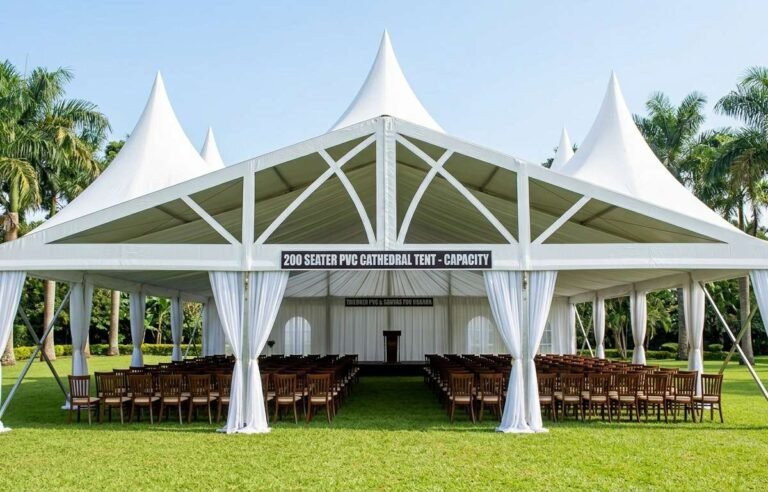
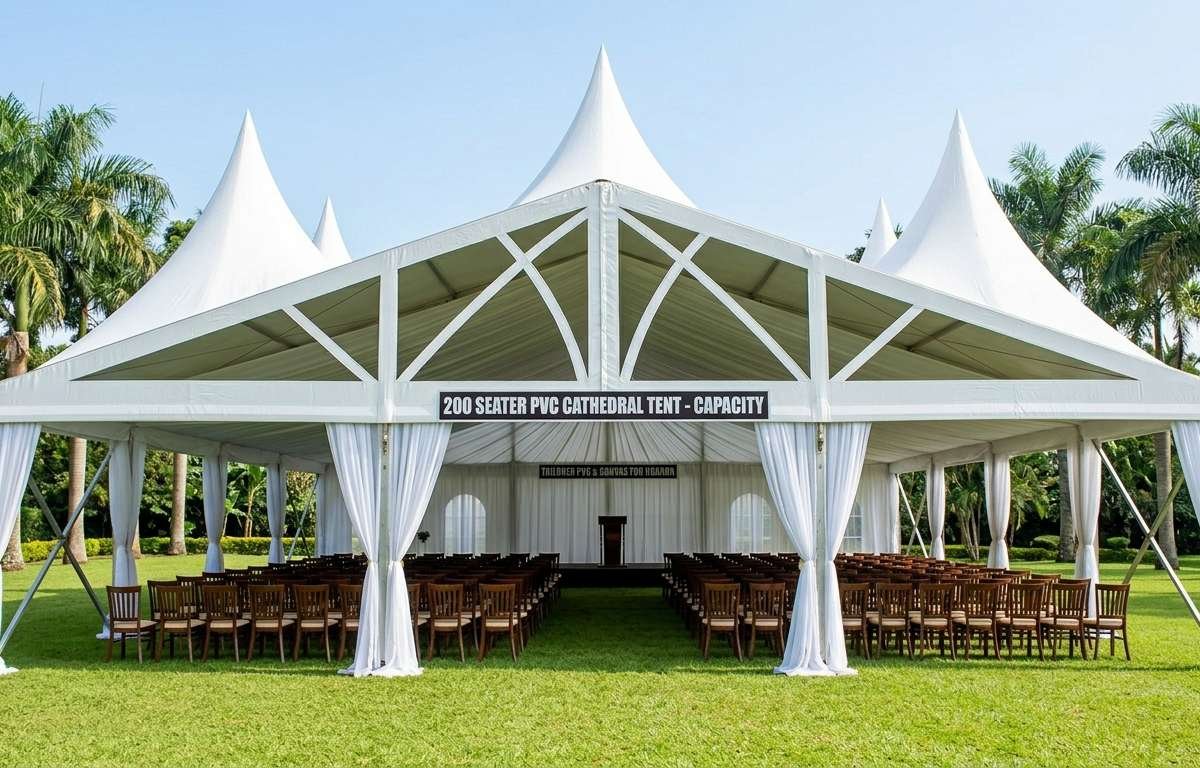
200 to 250 Seater Tents: Ranging from 8-meter by 15-meter up to 10-meter by 20-meter footprints. This tier serves as the baseline workhorse structure for established community churches outside Kampala’s central business district.
-
300 Seater Tents: Typically measuring roughly 9 meters by 14 meters or 10 meters by 24 meters. This tier provides wide interior layouts that accommodate traditional choral arrangements and robust sound reinforcement speaker stacks.
-
500+ Seater Mega Tents: Ranging from 15 meters by 21 meters up to massive 20-meter by 50-meter clear-span aluminum modular structures. These configurations are built exclusively for regional headquarters, high-density metropolitan revival Crusades, and fast-growing urban ministries.
Pillar 2: Financial Planning, Current Pricing, and Sourcing Channels
3. What is the current market price for church tents for sale in Uganda?
The financial investment required to purchase a church tent in Uganda depends heavily on the chosen framework design, metal pipeline thickness, fabric grade, and optional additions like ceiling liners or window panels.
The baseline pricing matrix across major Ugandan fabrication centers currently reflects the following tiers:
| Seating Capacity Tier | Framework Design Style | Average Market Price Range (UGX) | Essential Structural Features |
| 50 Seater | Pyramid Frame / Peg & Pole | UGX 1,350,000 – UGX 1,800,000 | 1.5mm standard steel pipes, standard PVC |
| 100 Seater | Standard A-Frame / Ridge Line | UGX 2,800,000 – UGX 4,500,000 | 1.5mm to 2.0mm pipes, options for window panels |
| 200 Seater | Heavy-Duty Peg & Pole / Alpine | UGX 5,500,000 – UGX 7,800,000 | Reinforced guy-wire ropes, thick side-walls |
| 300 Seater | Dome Structure / Heavy Frame | UGX 16,500,000 – UGX 21,500,000 | 2.0mm minimum pipe thickness, harsh weather build |
| 500 Seater (Mega) | Heavy-Duty Modular Truss / A-Frame | UGX 32,000,000 – UGX 45,000,000+ | Advanced clear-span aluminum/steel box arches |
4. Who are the leading local manufacturers and fabricators in Uganda?
The manufacturing hub for professional industrial canvas and heavy-duty structural PVC fabrication is centered around Kampala’s Central Division, extending down toward Nakawa and Rubaga along major transit pathways:
-
Located prominently along Jinja Road in Kireka, Kampala. They are widely recognized as an established domestic manufacturer specializing in high-frequency mechanized PVC welding, rip-stop canvas treatments, and custom steel frame fabrication across industrial, residential, and religious sectors.
-
Operating out of Namungoona (Rubaga Division). They are heavily sought after by church committees for producing mid-to-large capacity heavy-duty dome and A-frame configurations tailored from resilient fabrics designed to handle local tropical weather storms.
-
Based within Kampala’s Central Division. They focus on supplying ready-made and custom-tailored church tents, offering integrated fabric options like interior ceiling liners and custom window configurations.
                     KAMPALA FABRICATION HUB MAP
                      (Central & Eastern Axis)
                                 |
     +---------------------------+---------------------------+
     |                                                       |
     v                                                       v
[ Rubaga / Namungoona Axis ]                [ Jinja Road / Kireka Corridor ]
- (Dome/Heavy Frame Focus)                  - (Canvas/PVC)
                                            - (Liners/Custom Specs)
Pillar 3: Framework Engineering and Structural Integrity
5. What are the key differences between Peg & Pole Tents and Frame Tents for regular church use?
The structural framework determines how well a tent handles wind, how easy it is to set up, and where it can be safely positioned:
-
Peg & Pole Tents: These rely on a series of tall central upright support pillars to hold up the canopy’s peak, combined with tensioned perimeter guy-ropes anchored to iron stakes driven directly into the earth. They are highly economical, easy to transport in light vehicles, and simple to repair. However, they can only be installed on soft, penetrable ground like grass or dirt fields. The large center poles can also block views of the pulpit from certain seating angles.
-
Frame Tents: These use a self-supporting structural skeleton assembled from interlocking steel or aluminum tubing. The exterior waterproof fabric is stretched and tensioned directly over this rigid framework. Because the structure does not rely on perimeter stakes for its shape, frame tents can be safely installed on concrete parking spaces, brick paved lots, or hard rocky ground using weights or anchor bolts. This style keeps the entire interior floor plan open and unobstructed by support poles, providing perfect sightlines for the entire congregation.
6. What are Alpine Tents and clear-span aluminum structures, and when should a ministry invest in them?
-
Alpine Tents: Large, high-peak temporary structures inspired by geometric alpine architecture. They feature sharp peak lines and dipping fabric valleys designed aerodynamics in mind. This unique shape easily deflects strong crosswinds, making them an excellent choice for ministries holding services in open, breezy areas like exposed hillsides or large lakeside fields.
-
Clear-Span Aluminum Structures: The premium standard for mega-churches and large regional convention centers. They swap out steel pipes for high-strength extrusions of modular structural aluminum box profiles. This design completely eliminates internal support poles and external guy-ropes, creating a wide, open interior similar to a permanent building. They are highly durable, completely rust-proof, and can scale up to lengths exceeding 50 meters, though they require a larger upfront financial investment and specialized installation teams.
7. What steel pipe specifications are necessary to prevent a church tent from buckling during windstorms?
When evaluating local fabricators, never look at fabric color alone; always check the wall thickness and diameter of the structural piping.
Cheap, low-grade framework packages often use light-gauge conduit pipes (under 1.0mm) that can fold or snap under the sudden pressure of tropical storm downpours.
-
Pipe Material: Demand rust-resistant Galvanized Iron Pipes (GIP) or powder-coated structural steel tubing. This protection is essential to prevent interior and exterior rust from weakening the joints over years of humid outdoor exposure.
-
Wall Thickness: The pipe walls must measure at least 1.5mm to 2.0mm thick. For large, high-capacity spans exceeding 200 seats, look for primary structural trusses with a minimum thickness of 2.0mm to 2.5mm.
-
Joint Connections: Interlocking connection joints should feature sleeves with built-in spring pins or heavy-duty locking bolt assemblies rather than simple friction fits. This secure connection ensures the framework stays locked together during sustained high winds.
Pillar 4: Fabric Science, Material Selection, and Customization
8. What fabric grade handles Ugandan weather best: Heavy-Duty PVC or Canvas?
The choice between Polyvinyl Chloride (PVC) and woven canvas depends on your ministry’s long-term deployment plans:
-
Heavy-Duty PVC (Polyvinyl Chloride): The most popular and practical material for long-term outdoor installations across East Africa. High-quality PVC membranes are completely waterproof, naturally flame-retardant, and easy to wash clean with standard detergents. Look for fabrics rated between 550gsm and 850gsm (grams per square meter) with built-in UV blocks to prevent the material from yellowing, cracking, or breaking down under the intense equatorial sun.
-
Waterproof Canvas: Woven from heavy cotton or synthetic fibers treated with weatherproofing waxes or oils. Canvas is highly valued because it breathes naturally. This airflow reduces indoor heat buildup and condensation during hot afternoons, offering a cooler, more comfortable interior for the congregation. However, canvas requires regular maintenance, can mildew if packed away wet, and is generally heavier to handle and transport than synthetic PVC covers.
9. What are custom branded church tents, and how are they fabricated?
Custom branded tents allow ministries to print ministries’ names, logos, or outreach themes directly onto the exterior fabric panels before assembly.
[ RAW PVC / CANVAS ROLL ]
           |
           v
[ INDUSTRIAL WIDE-FORMAT PRINTING ] --> Applies Church Logo / Fonts / Pantones
           |
           v
[ HIGH-FREQUENCY THERMAL WELDING ]  --> Bonds fabric seams permanently without needles
           |
           v
[ FINAL BRANDED SANCTUARY CANOPY ]
Industrial manufacturers use automated wide-format printers running specialized UV-curable inks to print crisp text, customized borders, or scripture references onto raw fabric rolls. Once printed, the fabric is trimmed and assembled. This custom printing helps traveling ministries stay easily recognizable during out-of-town outreach events, community prayer missions, and regional crusades.
10. Why should a church demand high-frequency thermal welded seams over traditional mechanical stitching?
Traditional sewing machines use mechanical needles that punch thousands of tiny holes through the fabric layers. Over time, as wind stresses pull at the seams, these needle holes stretch out, allowing rainwater to slowly drip down onto the congregation and sound equipment.
High-frequency thermal welding avoids this entirely by using targeted electromagnetic energy and pressure to fuse the overlapping sheets of PVC together at a molecular level. This process creates a single, continuous sheet of fabric with completely seamless bonds that are entirely waterproof, incredibly strong, and won’t pull apart under intense wind pressure.
Pillar 4: Maximizing Interior Comfort, Decoration, and Audio Acoustics
11. How do interior decorative ceiling liners transform a basic PVC church tent?
While heavy-duty white PVC is excellent for weather protection, a raw unlined roof can feel industrial and capture a lot of heat during warm afternoon services. Adding an interior decorative ceiling liner completely softens the space.
These lightweight fabric inserts—typically tailored from single-knit polyester, organza, or satin sheets—clip directly onto the interior framework trusses. They drape elegantly across the ceiling to mask raw metal support pipes, wiring harnesses, and bracket connections, instantly creating a warm, beautiful, and reverent space for worship services.
+-------------------------------------------------------------+
|               STRUCTURAL ROOF PVC OVERLAY                   |
+-------------------------------------------------------------+
|  [=== Metal Framework Piping / Wiring Assemblies ===]      |
+-------------------------------------------------------------+
| ~ ~ ~ ~ ~ ~ SOFT POLYESTER DRAPING LINER ~ ~ ~ ~ ~ ~ ~ ~ ~  |
+-------------------------------------------------------------+
|                CLEAN INTERIOR SANCTUARY SPACE               |
+-------------------------------------------------------------+
12. How do church tents affect sound acoustics, and how can echo be managed?
Large, unlined PVC or frame tents have smooth, non-porous interior surfaces that act like giant acoustic mirrors. When a worship team plays or a pastor speaks, the sound waves bounce off the flat PVC walls and roof, creating heavy echoes, mudded audio, and low vocal clarity for the congregation.
Ministries can manage these acoustic challenges using several simple strategies:
-
Install Fabric Draping and Liners: Adding lightweight fabric ceiling liners or side drapes breaks up flat surfaces, absorbing mid-and-high frequency sound waves to reduce overall room echo.
-
Use Strategic Speaker Placement: Instead of using two massive speakers blasting at high volume from the front stage all the way to the back, install a delayed distributed system with several smaller speakers positioned further down the seating rows pointing downward toward the audience. This configuration delivers clean, clear audio to every row without overloading the space with excessive volume.
-
Lay Down Ground Carpeting: Placing woven fiber mats or artificial turf carpets across high-traffic aisleways prevents sound from bouncing off hard dirt or concrete floors, while also deadening the distracting noise of foot traffic during the service.
Pillar 5: Maintenance, Longevity, and Safe Operational Practices
13. What routine maintenance steps will extend the lifespan of a PVC church tent?
A well-maintained heavy-duty PVC tent can easily deliver 7 to 10+ years of dependable service. Protecting your investment requires simple, disciplined care:
-
Never Pack Away Wet Fabric: If you must take the tent down immediately after a rainstorm, unfold it and let it air dry completely in a well-ventilated space within 24 to 48 hours. Storing damp PVC or canvas traps moisture, which quickly leads to dark mildew growth, foul odors, and weakened seams.
-
Wash Surfaces Regularly: Periodically wash away bird droppings, tree sap, and accumulated dust using a soft bristle brush, mild dish soap, and warm water. Avoid harsh chemical solvents or abrasive bleach solutions, as these can strip away the fabric’s protective UV-resistant topcoat.
-
Inspect Hardware Joints: Periodically check all metal frame components for minor scratches or surface rust. Sand down any rust spots immediately and touch them up with a coat of zinc-rich anti-corrosion primer to keep the structural framework strong.
14. What emergency safety protocols should a church committee enforce during severe weather?
While modern engineered church tents are exceptionally durable, extreme weather events require clear safety guidelines to protect your congregation:
-
Establish Regular Cable Checks: For peg and pole or alpine configurations, designate a team to check the tension of perimeter guy-ropes and iron stakes before every service, ensuring everything is tight and secure.
-
Monitor Wind Thresholds: If a severe storm brings extreme tracking winds that cause the main support poles to lift or the metal framework to twist visibly, evacuate the structure immediately.
-
Manage Electrical Lines Safely: Ensure all power cables feeding your musical instruments, mixing consoles, and heavy loudspeakers are run through weather-insulated rubber conduits. Keep all main power distros elevated off the ground to prevent short circuits if water puddles near the edge of the tent during a sudden downpour.
Pillar 6: Comprehensive Purchasing Checklist for Ministries
Before finalizing an agreement with any local manufacturing center or signing a procurement contract, ensure your church committee walks through this comprehensive technical checklist:
-
[ ] Capacity Validation: Does the specified seating capacity leave enough room for a raised altar platform, your musical instruments, and wide safety walkways?
-
[ ] Undercarriage Alignment: Is the structure a frame style that can be anchored to hard surfaces, or a peg and pole layout restricted to grass and dirt fields?
-
[ ] Pipe Gauge Metrics: Have you verified that the structural pipes feature a wall thickness of at least 1.5mm to 2.0mm made of rust-resistant galvanized iron?
-
[ ] Fabric Mass Verification: Is the canopy membrane made from heavy-duty PVC rated between 550gsm and 850gsm with built-in UV and flame protection?
-
[ ] Seam Engineering: Are all major fabric seams fused using clean high-frequency thermal welding rather than simple needle stitching?
-
[ ] Acoustic & Interior Styling Plan: Have you factored in the cost of interior fabric liners to help manage heat and improve sound clarity during services?
-
[ ] Logistics & Storage: Does the package include durable storage bags and a clear instruction manual for your team to safely handle installation and teardown?